
Sunday Summary, JAN25
A week in review from the Editor
Nietzsche said something
About looking into abysses and abysses looking back into you. It’s the kind of thing you can say at an undergraduate house party with a Keystone Light in your hand, surrounded by poly-science majors, and always get a round of knowing nods.
It’s deep, man.
Most have heard the mustachioed philosopher’s thoughts on abysses, but few have read the line that comes immediately before it:
“Battle not with monsters, lest ye become a monster
, and if you gaze into the abyss, the abyss gazes also into you.”-Freddy N. (emphasis added)
In short: when you push on the world, the world pushes back on you in a self-similar way.
If you fuel yourself with violence and rage to fight monsters, you should be cautious about turning yourself into a monster, and not be surprised when you wake up in the morning and hurl the Cheerios box across the kitchen in a fit of age because the milk is out.
Similarly, if you fuel yourself with the discipline to conquer your health and fitness (and maybe run that marathon you’ve always talked about), you shouldn’t be surprised when you wake up one day, fresh faced, limber and surrounded by beautiful, healthy people.
You get what you give.
Nietzsche died long before the formalization of large language models, so we won’t be getting his thoughts on AI development, but I like to imagine an employee at ChatGPT, Grok, or Anthropic catching up with their colleagues (maybe even holding a Keystone Light?) and warning them of the Nietzschean implications surrounding their next model release.
The intern might reply, “That’s not an insight—that’s a revolution!”
There are certain words and phrases that LLMs just like using. It’s not X—it’s Y (and yes, that’s a revolution)—Delving, meticulous, adept, realm. Ephemeral half-sensory terminology, disconnected from a certain feeling of humanity.
Sam Crist, in New York Times, addressed this in an article titled, Why Does A.I. Write Like…That?.
Something is wrong here; this text is not what it says it is. It’s one of them. Entirely ordinary words, like “tapestry,” which has been innocently describing a kind of vertical carpet for more than 500 years, make me suddenly tense. I’m driven to the point of fury by any sentence following the pattern “It’s not X, it’s Y,” even though this totally normal construction appears in such generally well-received bodies of literature as the Bible and Shakespeare. But whatever these little quirks of language used to mean, that’s not what they mean any more. All of these are now telltale signs that what you’re reading was churned out by an A.I.
It’s the uncanny valley of writing. While aimlessly scrolling a social feed, or reading a Substack article, a turn of phrase, a word, snaps you into scared reality.
You’re not listening to the person behind the avatar.
You’re listening to a ChatGPT subscription.
Battle not with large language models lest ye become a large language model.
A recent study, published by the Max-Planck Institute for Human Development, showed just this. Not only have we trained the LLMs, the LLMs have trained us.
The researchers transcribed 280,000 academic presentation videos from 20,000 YouTube channels both before and after the launch of ChatGPT.
The results are a bit shocking.
After the launch of ChatGPT academics started using certain words more often.
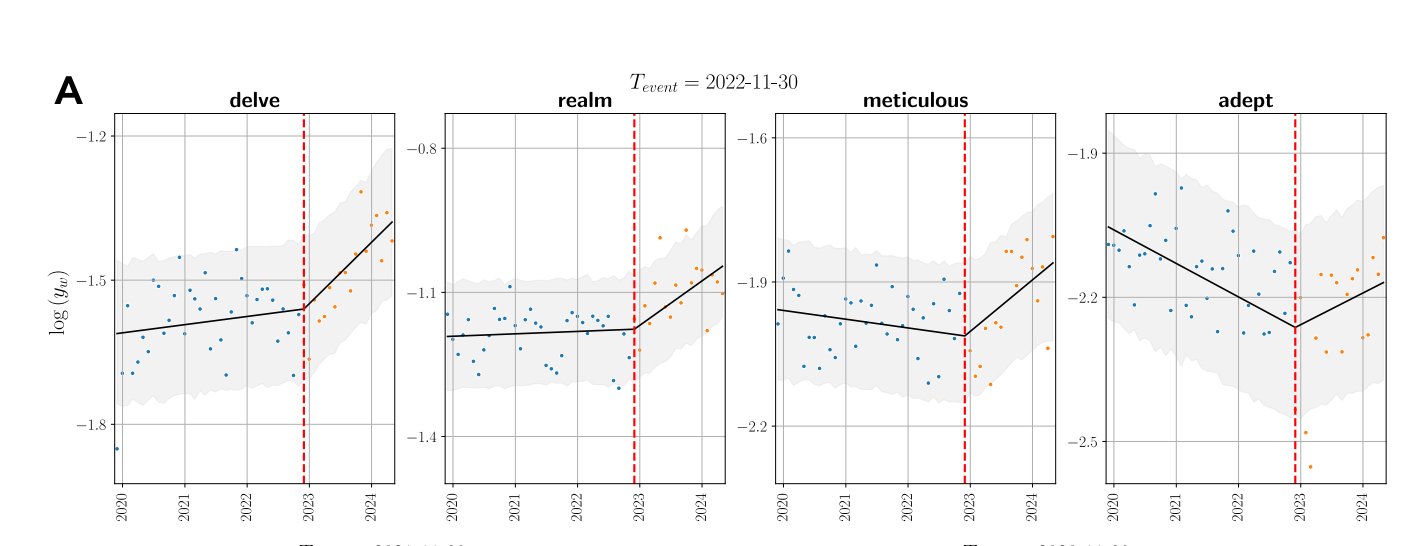
The loss of mental autonomy?
If academics can be trained, en masse, by LLMs to subtly shift their language, what does this mean for social media scrollers? For news readers? For the broader population who is barraged by thousands of messages a day?
In the age of AI, you must protect your mind.
Last September, Maple AI CEO, Mark Suman addressed the issue on the Imagine IF stage, with the opening question, “Imagine IF your memories could be edited?“ (Hint: they can)
He introduces the risk of AI not only modifying the way you think but, influencing the way you remember. He calls this subconscious censorship.
You’re being psychologically ‘nudged’ by a closed-source algorithm, and have absolutely no idea how or in which direction.
Over time, your language, your thoughts, and eventually your memories have shifted.
The solution he says, is to ‘Think Open’.
Open-source the models. Open-source the training. Open-source the profiles.
Nietzsche would have agreed.
In a world of LLM monsters and abysses, he offers a similar remedy in The Joyful Wisdom:
We do not belong to those who only get their thoughts from LLMs
books, or at the prompting of LLMsbooks,—it is our custom to think in the openairsource, walking, leaping, climbing, or dancing on lonesome mountains by preference, or close to the sea, where even the paths become thoughtful.
Maybe the problem is not such a new one?
And maybe the remedy is the same as it ever was, to fight to remain human, all too human.